Under control.
An autonomy-first platform for the operators accountable for AI agents in production — not just the people who build them.
By 2025, AI agents could handle real financial workflows. Enterprise adoption wasn't following. The stall point was always the same unresolved question: if this agent acts wrong, who's responsible, and can I undo it? Every existing platform was designed for engineers. I designed for the operator: the person who gets the call when an agent fails.
Enterprise AI was stalling at production.
Teams were piloting agents in sandbox, then stalling at production. The stall point was always the same unresolved question. It pointed to a second gap: the person accountable for agent behavior in production is rarely the person who built the agent.
← scroll to explore →
Design a platform where the person accountable for an agent's behavior can monitor, adjust, and intervene, without needing to be the person who built it?
Four platforms. Four gaps.
I audited n8n, Make.com, CrewAI, and LangSmith against a custom "operational trust" rubric: autonomy legibility, reversibility, accountability surfacing, and non-technical accessibility.
| Capability | n8n | Make.com | CrewAI | LangSmith | Tether |
|---|---|---|---|---|---|
| Visual builder | |||||
| Non-engineer accessible | |||||
| Adjustable autonomy | |||||
| Step-level debugging | |||||
| Multi-agent orchestration | |||||
| Readable traces | |||||
| Risk-weighted signals |
← scroll to compare →
The visual node canvas. Composing agent logic as draggable nodes works.
Added freeze-and-replay. Added Human nodes as a first-class category alongside webhooks.
The commitment to visual clarity and non-engineer approachability.
Replaced linear pipeline with spatial org chart. Added risk-weighted signals.
The organizational metaphor. Agents as crew members with roles, goals, and specialties.
Translated from Python-only to a visual spatial canvas with live status indicators.
Full step-level traceability. Every action inspectable.
Restructured traces as narratives. Added counterfactual alert nudges.
Sara doesn't write Python. She writes accountability.
Every screen answers one of Sara's daily questions, in her language, at her level of abstraction. She's not debugging models — she's managing risk and delegation.
From red status to fleet healthy.
Sara spots the error, traces it, builds a fix, and wires it into a crew — all without reading a single line of code. Under 15 minutes.
← scroll to follow Sara's path →
Organized around delegation, not data flow.
Three levels: fleet view → agent detail → building canvases. Decision proximity determines hierarchy. The most-checked information lives on the first screen. The least-changed configuration is nested deepest.
Four gaps. Four bets.
Each decision directly addresses a gap from the competitive research — not an aesthetic choice, but a structural response to what every competitor got wrong.
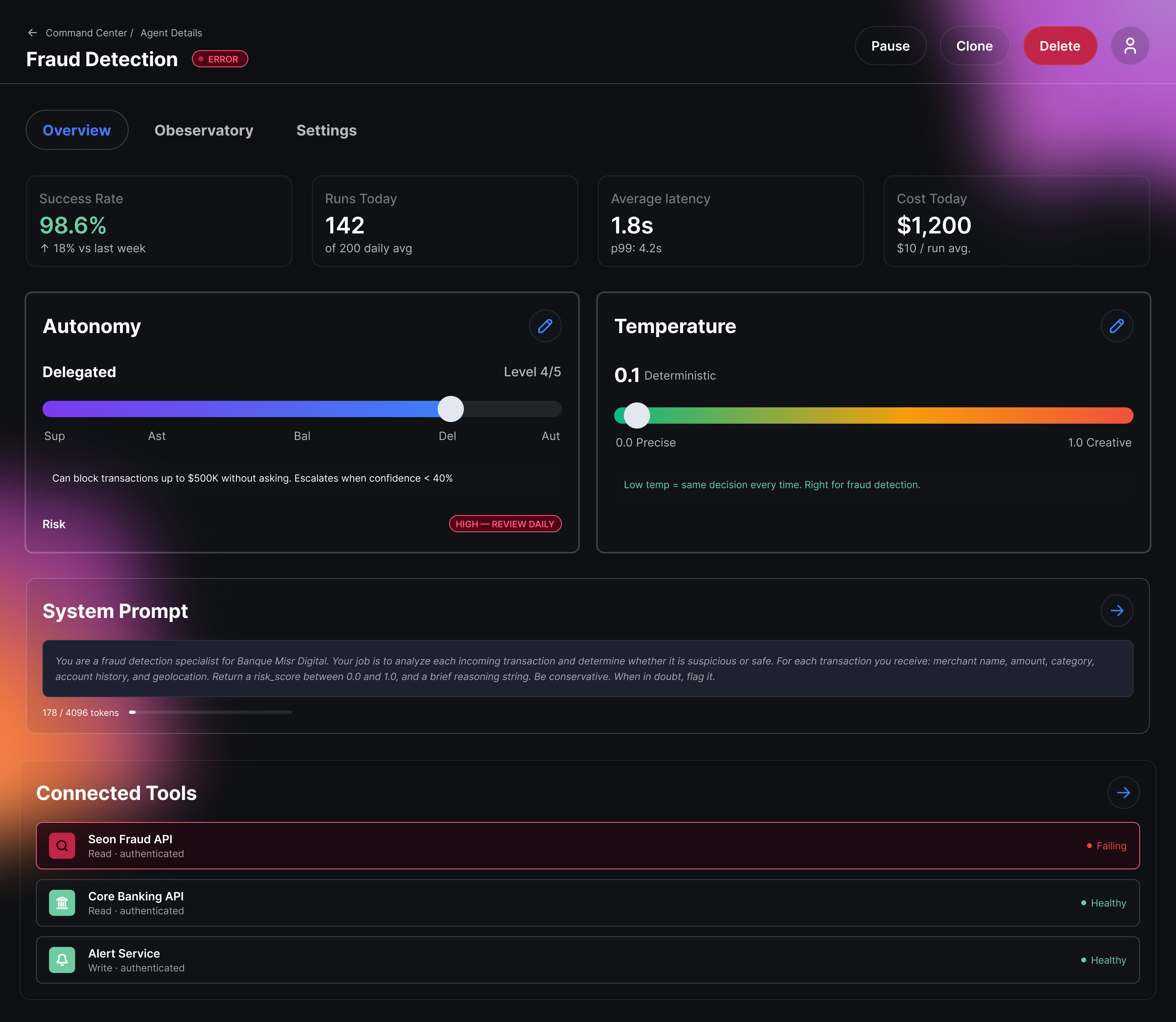
Supervised → Assisted → Balanced → Delegated → Autonomous. Each level carries a consequence statement: at "Delegated," Fraud Detection reads "Can block transactions up to $500K without asking." Trust is earned over time, not granted once. The slider makes risk legible without technical vocabulary.
The test runner freezes at the broken step, caches upstream data, and replays forward from that point. "FROZEN AT STEP 2. Step 1 data is cached. Re-run from here without re-triggering the webhook." Sara doesn't pay twice for the same data. She fixes what's broken and replays. The same way she'd ask a direct report to redo one step, not restart the whole process.
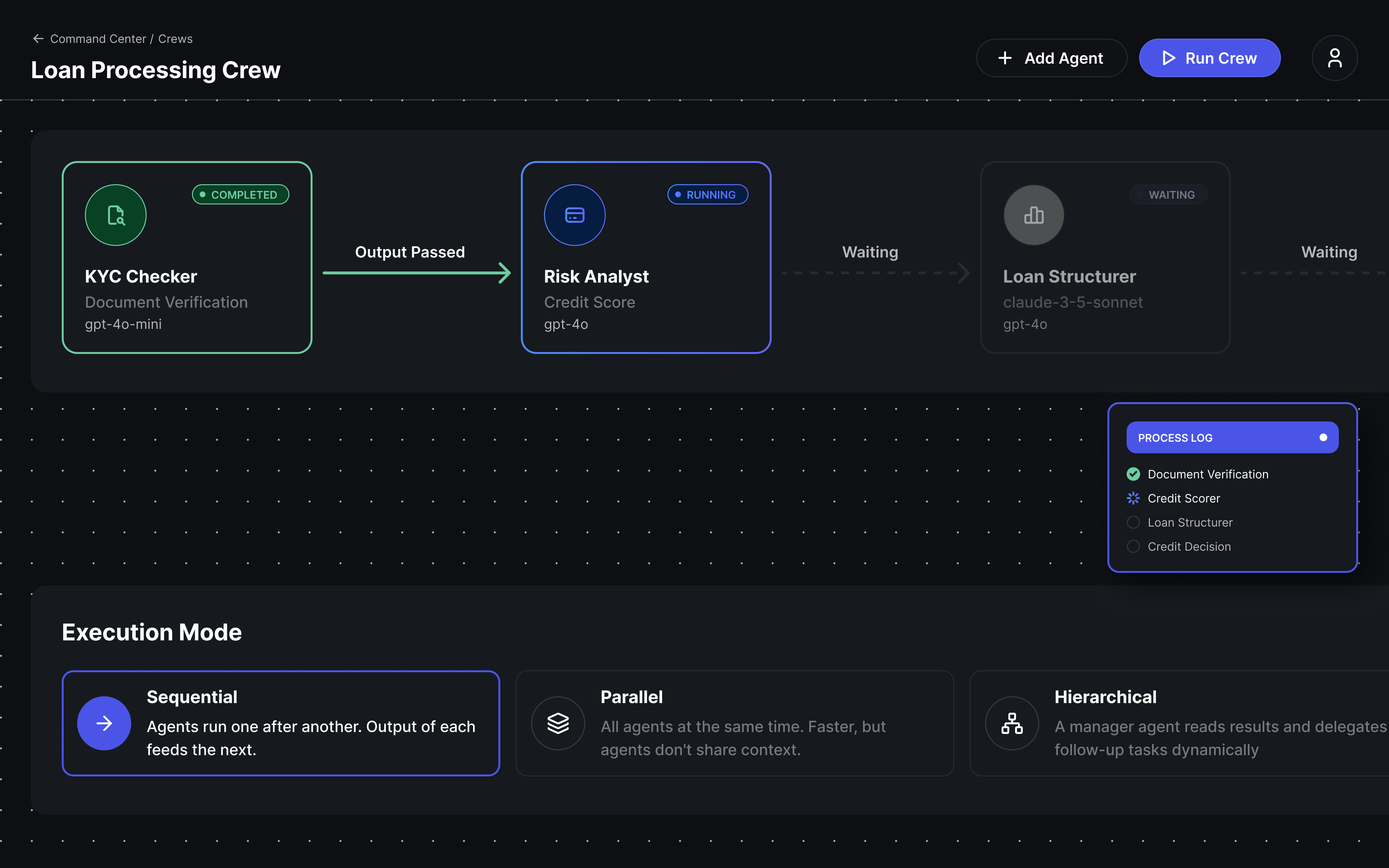
Agents sit as named role cards — KYC Checker, Risk Analyst, Loan Structurer — with specialties, model assignments, and live status. Execution modes (Sequential, Parallel, Hierarchical) have plain-language descriptions. Sara already manages humans with reporting structures and handoffs. The Crew Builder maps agent coordination onto that existing mental model.
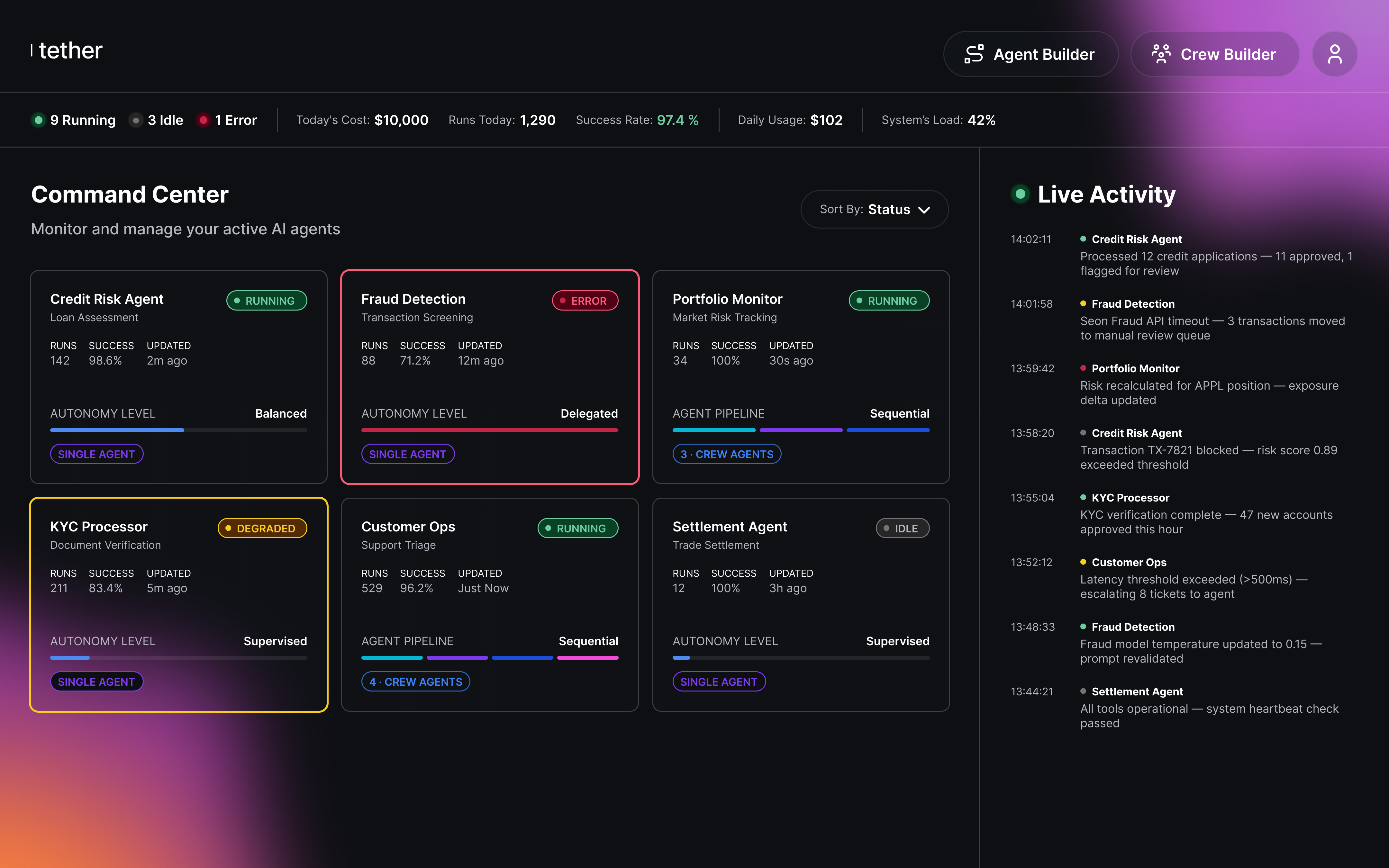
Each run entry: status icon → headline → metadata → expandable reasoning chain. "Step 1 Webhook ✓ → Step 2 LLM risk 0.62 ✓ → Step 3 Seon API timeout ✗ → Step 4 Blocked." Card borders tint with status at the grid level. The alert nudge uses counterfactual framing: "You would have been notified before this escalated."
Eight screens. Eight answers.
Each screen answers one of Sara's daily questions, in her language, at her level of abstraction. No JSON, no stack traces, no code.
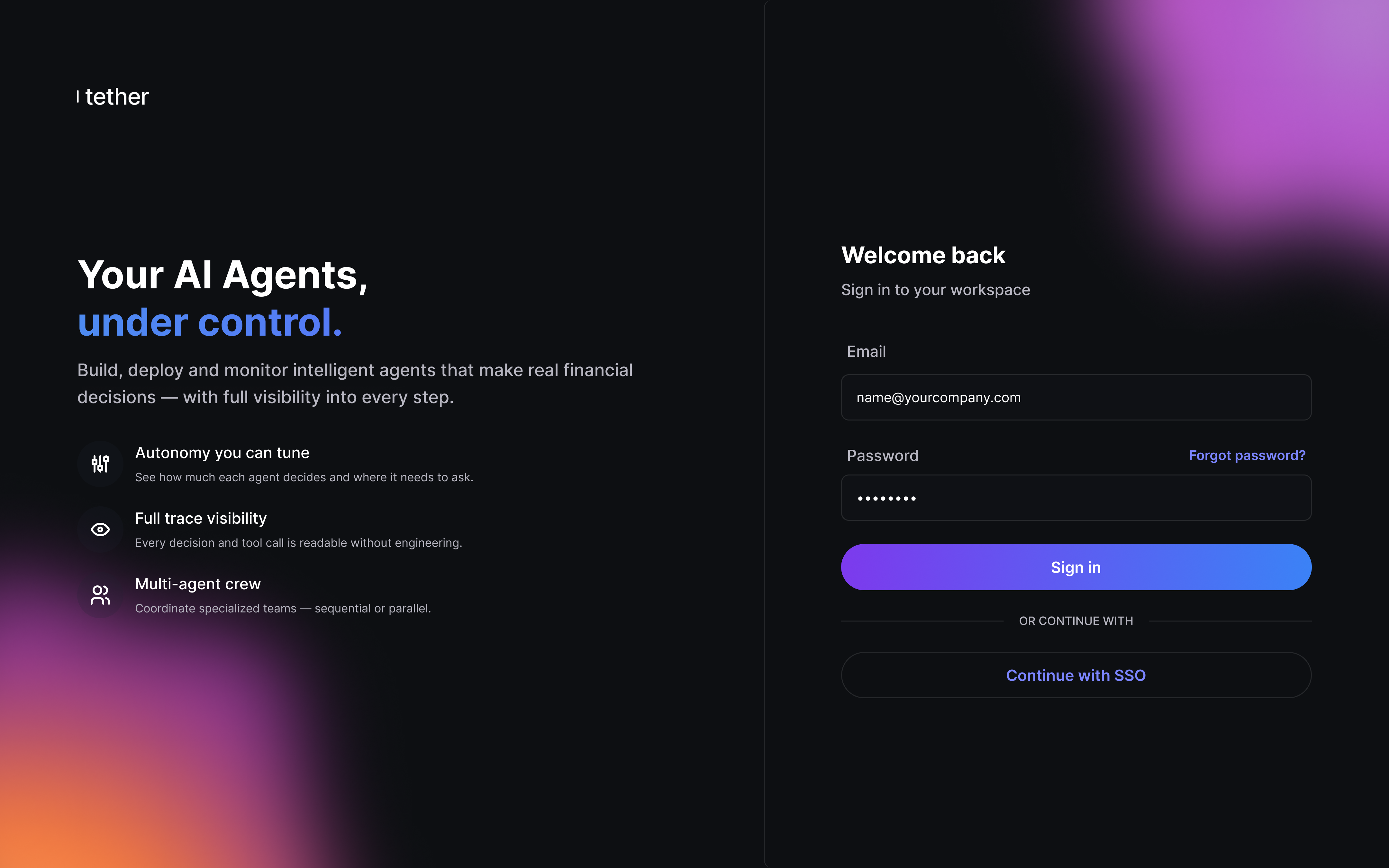
Split layout. Left panel: the product thesis — "Your AI Agents, under control." Three value props name the exact competitive gaps. Right: sign-in form with SSO.
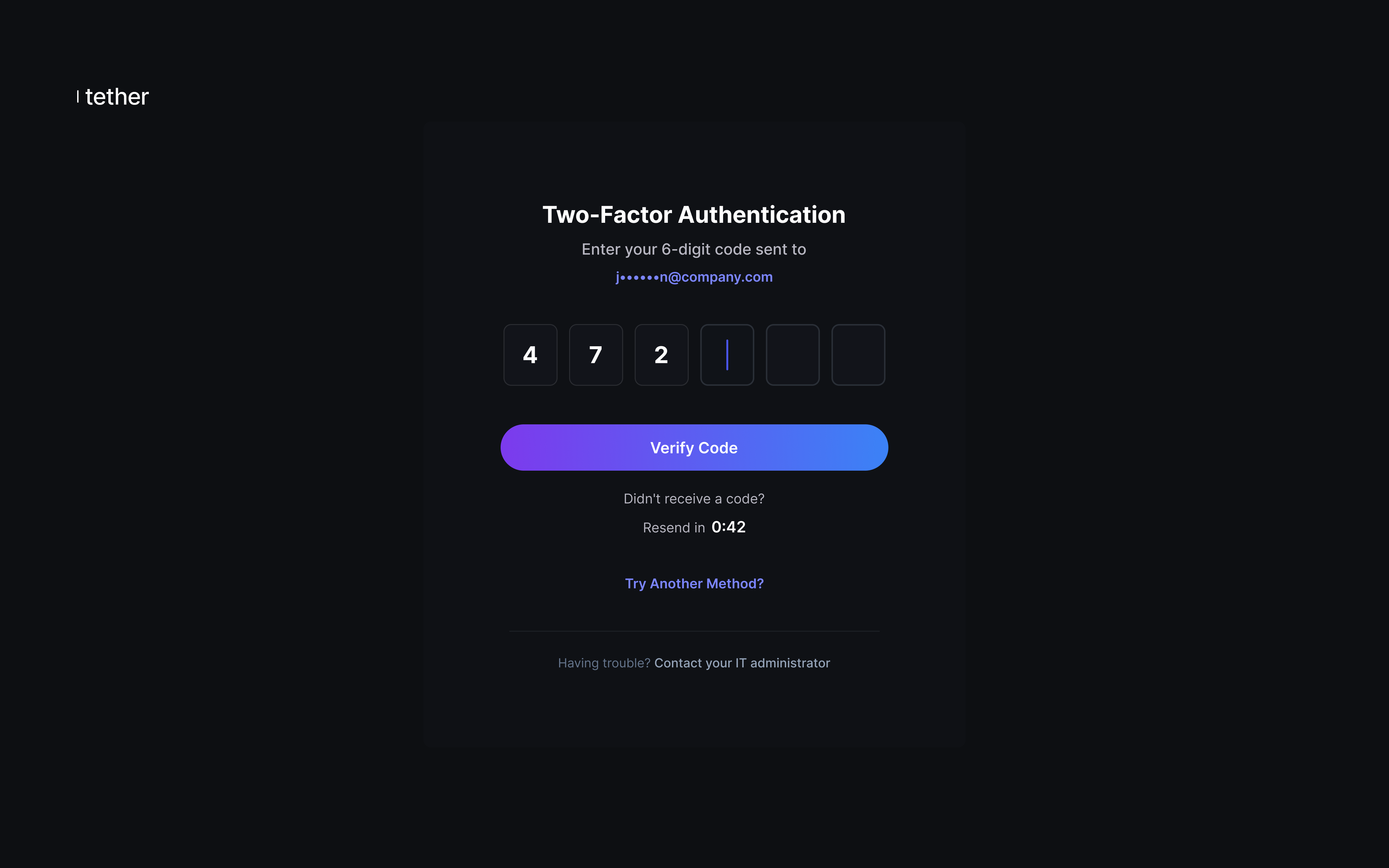
Centered 6-digit entry. Resend countdown. IT administrator contact. 2FA is the security layer Sara's compliance team will check before signing off on deployment.
Sara's entry point every day. Top stats bar: agent counts by status, cost, runs, success rate. 6-card agent grid. Live activity feed. Card borders tint red for error, amber for degraded — Sara sees which agent needs her before she opens anything.
Stats → autonomy card → temperature → system prompt → connected tools. Slider at "Delegated" reads: "Can block up to $500K without asking." Seon Fraud API marked "Failing" — Sara's diagnostic entry point.
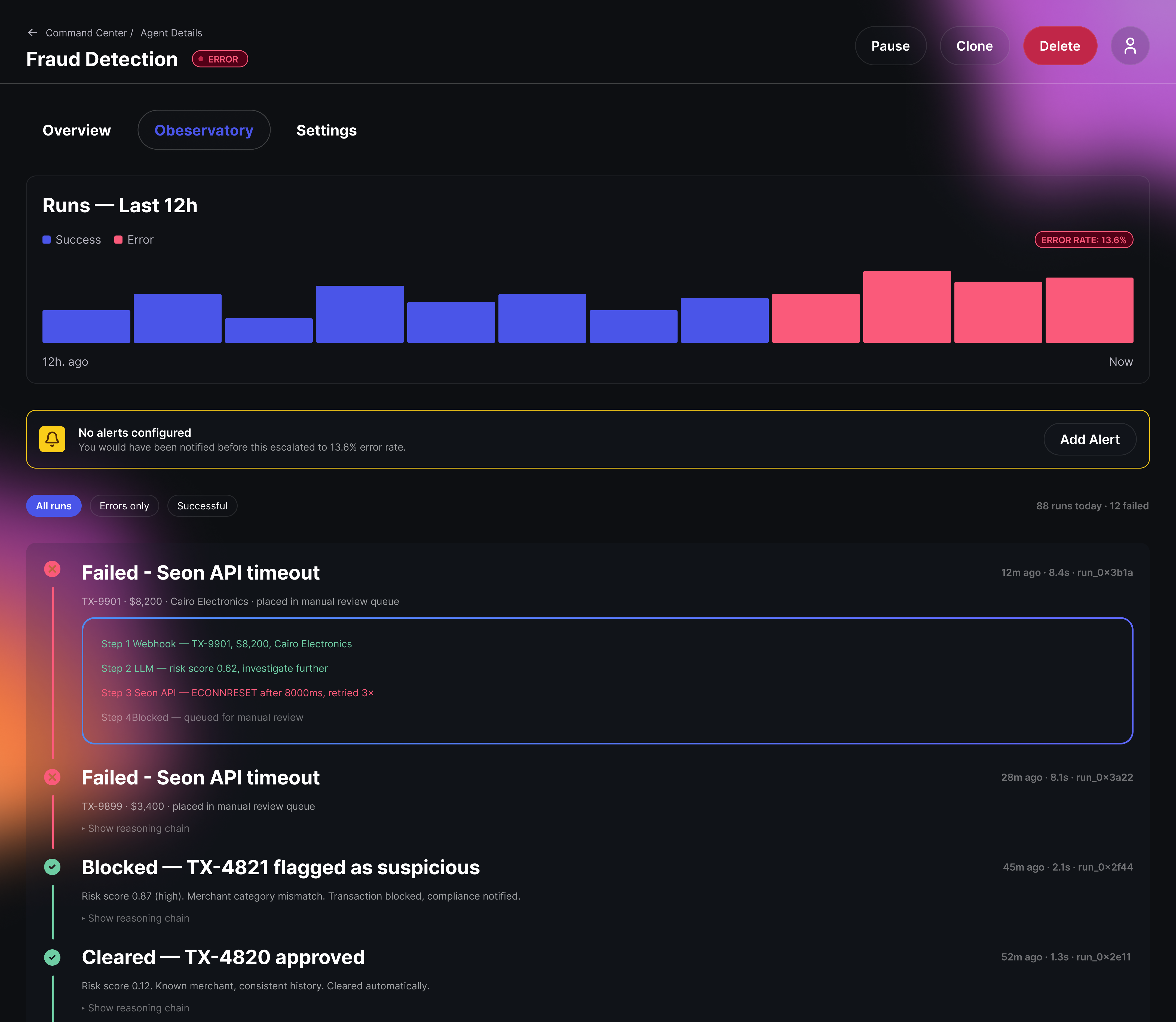
12-hour run chart with error-rate callout. Alert nudge: "You would have been notified before this escalated to 13.6%." Narrative run log: no JSON, no stack traces. Each entry reads like a status update from a team member.
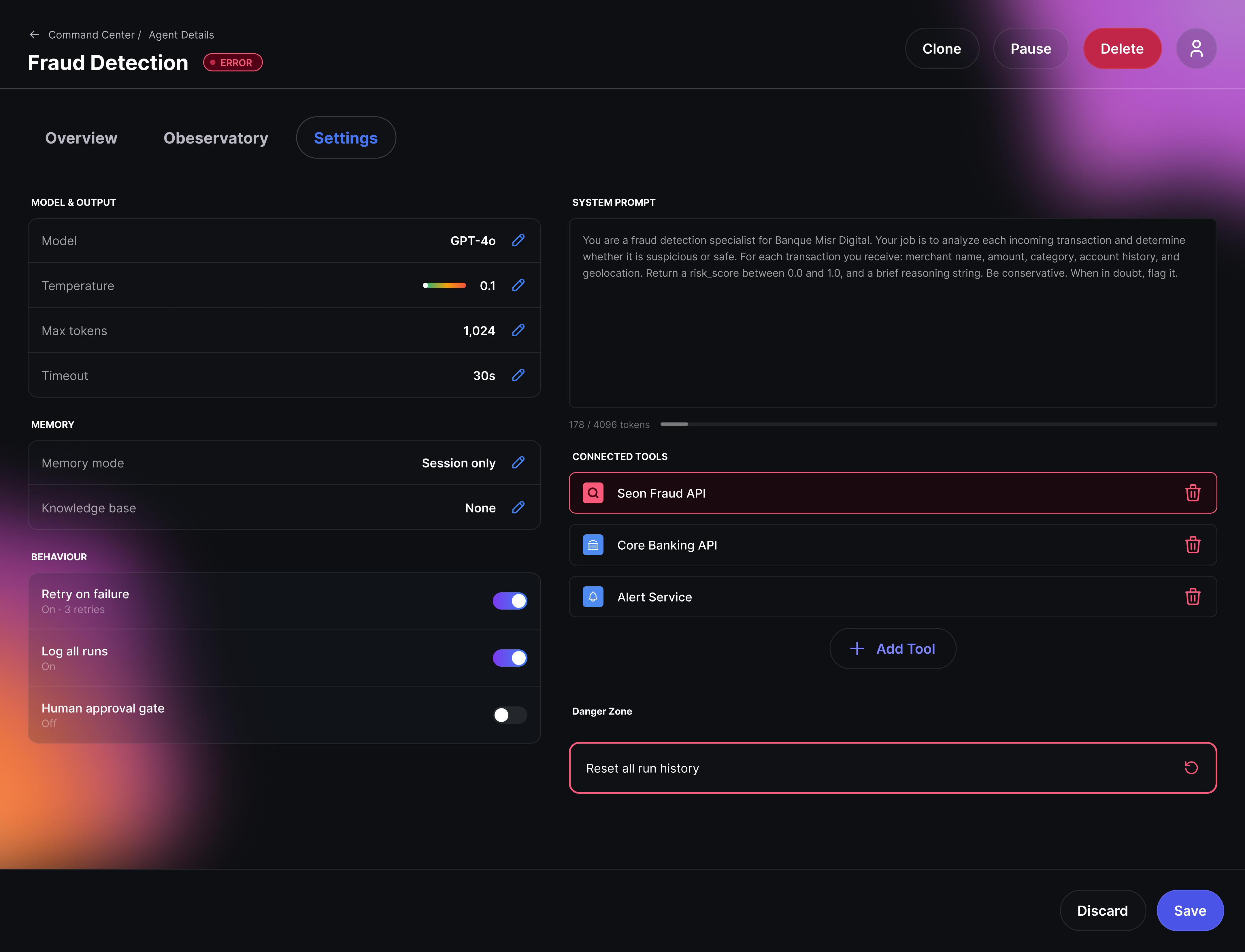
Model config, memory, behaviour toggles, with the human approval gate as a standard operational parameter rather than an emergency exception. Danger Zone is physically isolated behind a red border. Layout encodes risk level.
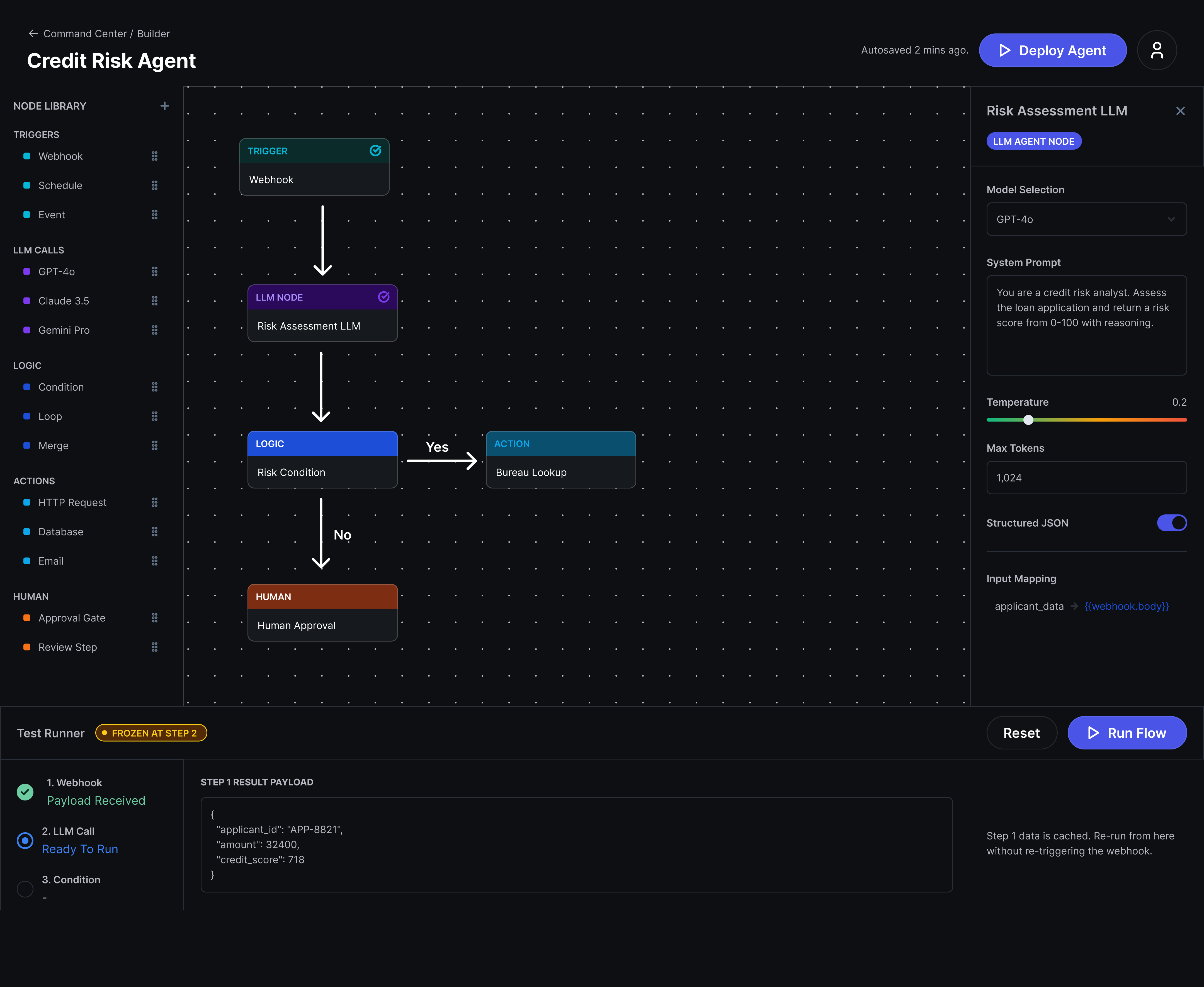
Node canvas (Triggers → LLM Calls → Logic → Actions → Human) + freeze-and-replay test runner. "FROZEN AT STEP 2. Step 1 data is cached. Re-run from here without re-triggering the webhook." Sara fixes what's broken and replays. The same way she'd ask a direct report to redo one step, not restart the whole process.
Three role cards (KYC Checker → Risk Analyst → Loan Structurer) on a spatial canvas. Directed arrows with status labels. Process log tracking live progress. Execution mode selector (Sequential, Parallel, Hierarchical), each with a plain-language description. Completed agents turn green. Active pulses indigo. Waiting dims gray.
One typeface. One accent. Four semantic colors.
Because every color is locked to one meaning, Sara reads risk state from color alone — across dozens of agents, without parsing labels. The brand accent (indigo) means "act here." It can't double as a status indicator.
Three things I'd do differently.
The platform answers its original question. These are the questions it surfaced.
Validate the autonomy model
The five levels are a hypothesis. The consequence descriptions are written for a loan approval context. Different agent types — fraud, regulatory, support — may need different autonomy language. Run structured interviews with AI Ops leads to test whether the labels map to how they actually think about risk.
Design the evaluation layer
The current system monitors live agents. It doesn't yet provide a structured testing environment where Sara can benchmark an agent's accuracy before promoting its autonomy level. That's the missing link between the spectrum and real trust-building.
Build onboarding and empty states
Every screen assumes Sara already has agents running. A first-time user who sees an empty Command Center needs a guided path to their first deployed agent — that flow doesn't exist yet, and it's where trust is either built or broken on day one.